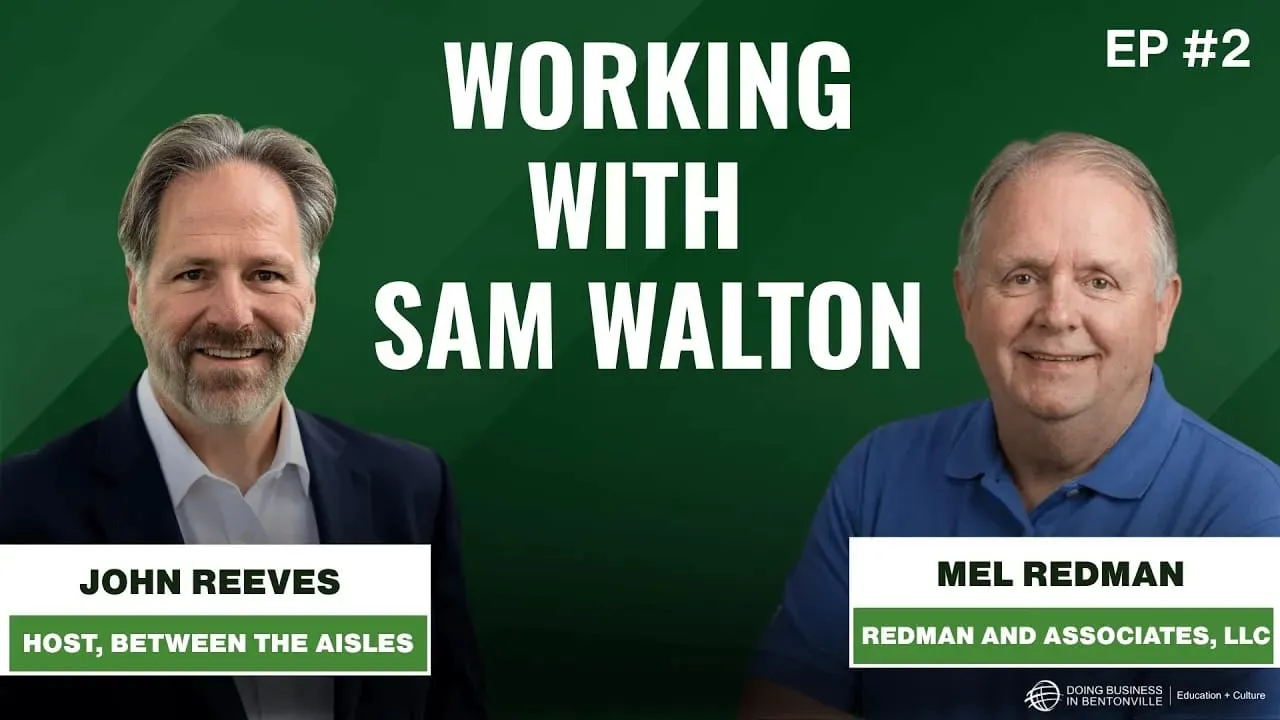
Company culture is the lifeblood of sustainable growth, yet it is often treated as a corporate buzzword rather than an operational strategy. When scaling an organization at breakneck speed, the risk of losing your core values increases exponentially. In this episode of Between the Aisles, legendary retail executive Mel Redman sits down to discuss how genuine operational culture serves as the ultimate engine for business growth, sharing firsthand accounts of expanding a global footprint without losing the corporate soul.
We sit down to discuss the exact operational mechanics required to manage hypergrowth during the foundational eras of retail. Mel gets into his early days with the company starting in 1978, the high-stakes conversion to front-end scanning, and the logistical realities of running store planning during a period of opening over one hundred locations a year. We unpack the massive undertaking of the 1994 Woolco Canada acquisition, where a handpicked transition team had to align thirty-eight thousand legacy SKUs with standard modular layouts, navigate strict national bilingual compliance laws, and win over a fearful workforce. Mel also reveals the leadership philosophies of Sam Walton, highlighting the distinct difference between executing a corporate directive and keeping field associates genuinely motivated.
The reality of executing this level of growth means dealing with immense pressure, rigid deadlines, and the brutal schedule of setup teams living out of suitcases forty-two weeks a year. Mel shares the harder lessons of international expansions, from racking up thousands of dollars in compliance fines to the difficult career re-entry process talent faces when returning from foreign expat assignments. Viewers will walk away with a profound mindset shift regarding corporate culture, moving it away from human resources theory and placing it squarely on the frontline execution map.
If you care about organizational leadership, scalable operational systems, and the history of global retail execution, you’ll get a lot from this conversation. Please make sure to subscribe and share this episode with a colleague. Let us know your thoughts in the comments section below: What is the most difficult aspect of keeping your team aligned during a period of rapid organizational change?
More About this Episode
The True Engine of Global Growth
When people look back at the meteoric rise of Walmart during the 1980s and 1990s, they tend to focus on the tangible mechanics of the business. Industry analysts point to our aggressive pricing strategy, our sophisticated supply chain, or the way we pioneered the data warehouse to capture item level sales at the front end with full blown scanning. Our competitors looked at us and assumed they could simply copy the blueprint. They figured that if they built the same size building, matched our retail prices, and adopted similar distribution methods, they could match our success.
What they never understood is that those things were just the vehicle. The fuel, the true engine of our growth, was our corporate culture.
Many companies treat culture as a vague HR concept or a set of words printed on a plaque in the home office. For us, culture was a living, breathing competitive advantage. It was a shared work ethic, a commitment to mutual respect, and a deep understanding that the front line hourly associates are the actual heart of the company. It is a philosophy that self disciplines: you either catch the culture, or the culture catches you.
Establishing the Cultural Vanguard
From 1986 through 1994, I had the privilege of leading the store planning division during one of the most intense growth periods in retail history. We were opening roughly 120 new stores a year and remodeling even more. It was a massive, high pressure operation that required absolute operational discipline.
We had a rigid rule to protect our efficiency. The blueprint that came inside the massive crate we called the deal box was sacred. That print dictated exactly how the modulars would be set, because it tied directly to how the new store merchandise had been ordered by the buyers in Bentonville. We could not let the layout be subject to personal opinion, because any variation would break the supply chain pipeline.
Yet, as rigid as the operational parameters were, the human element was entirely fluid, encouraging, and vibrant. For many newly hired associates in expansion states like California or the Pacific Northwest, their very first exposure to Walmart did not come from a corporate executive or a handbook. It came from our setup supervisors and office training supervisors.
Our setup teams lived out of suitcases for 42 weeks a year. They would arrive for fixture week, spend six weeks managing the store setup and training the new team, and then hand the keys over to the store manager before moving immediately to the next project. It was grueling work that required immense perseverance.
I always told our store planning teams that the mechanical job would always get done because a deadline forces it. The building will get built, the shelves will be stocked, and the doors will open. What truly matters is how those new associates feel about the process when it is done. Do they feel like they have accomplished something meaningful? Have they learned? Do they feel valued?
The excitement we injected into those setups, from teaching the Walmart cheer to organizing a zone defense where everyone stopped to clean the facility together, built a tight bond. Store planning created an incredibly tight-knit group, creating a powerful culture within the broader Walmart culture.
Leadership by Listening
The foundation of this entire philosophy came directly from our founder, Sam Walton. I was fortunate enough to work directly for him during my first year in store planning, and traveling with him was like attending the ultimate masterclass in business leadership.
When Sam visited a store, his approach was entirely counterintuitive to how most corporate executives operate. He didn't walk in to give orders or show how smart he was. He drew far more information out of the hourly associates and the local management than he ever imparted. He would carry a yellow legal pad, sometimes folded up as a prop, and ask questions. He wanted to know what was selling, what wasn't, what frustrations the team faced, and what the competition across the street was doing.
He would take those notes, roll them together, and bring that ground-level truth directly into our Friday and Saturday morning management meetings in Bentonville. Buyers would frequently get frantic phone calls from Sam right from a store floor. He would stand at a fabric counter or in the stockroom, hand the phone to a department manager, and tell the buyer to listen directly to the issues the front line was experiencing.
As a merchant, you had to know your business inside and out because you were the resident expert. You had to be on your game at all times because you could be called down to Sam's office or put on the spot in front of hundreds of people during a Saturday morning meeting.
Yet, Sam's intensity was always balanced by a profound sense of humility and a desire to teach. If you made a mistake or missed an item in stock, he didn't approach it as a moment to tear you down. He approached it as a customer who was disappointed, helping you understand the immense responsibility we had not to let down the people who chose to spend their hard-earned money with us. He allowed for healthy debate, but once a decision was finalized, the entire company executed it with absolute unity.
The Great Canadian Experiment
The true test of whether our culture was a universal human truth or just a regional phenomenon came in late 1993. The company made the monumental decision to acquire 122 Woolco stores in Canada, marking a massive step into international expansion. I was asked to lead this transition team.
When the acquisition was announced to the Woolco associates, the atmosphere was heavy with fear and grief. These were people who had dedicated 10, 20, or 30 years to Woolworth Canada, and they felt as though they had lost their best friend. They were suddenly faced with a massive corporate entity from the United States taking over their livelihood.
On top of the emotional hurdles, the operational realities were staggering. We arrived in Toronto in January during the coldest winter many of us had ever experienced. The Woolco stores were in terrible condition, characterized by cavernous stockrooms clogged with years of non-salable inventory that completely choked asset turnover. Our initial assignment was to crawl through these frozen, unheated stockrooms to audit and value the inventory while assessing the structural floor plans.
Operationally, we had to completely re-engineer the merchandise mix, expanding the product offering from 38,000 SKUs to nearly 90,000 SKUs to align with a standard Walmart assortment. We had to navigate national compliance laws requiring every single piece of merchandise, sign, and memo to be entirely bilingual in English and French. We rented an old warehouse in an industrial area of Toronto, called the Curity zone, where we built prototype layouts and mapped out every single floor plan, including our very first two-story store in Mississauga.
But the real challenge was not the logistics, the real challenge was bridging the cultural gap.
Many corporate observers in Toronto explicitly warned us that Canadians would never buy into our culture. They told us flatly that we would never get Canadian associates to do the Walmart cheer. They viewed our traditions as hokey American concepts that wouldn't translate.
We proved them wrong by focusing entirely on human connection. We showed the Canadian associates that our culture was not about regional pride, it was a genuine celebration of people. We broke down barriers by introducing lighthearted traditions like our word of the week to bridge language differences, and we adapted our corporate campaign around the theme You Ain't Seen Nothing Yet, paying homage to the classic track by the Canadian band Bachman-Turner Overdrive.
We instituted our own Friday morning meetings in Canada to mirror the energy of the Bentonville Saturday meetings. We brought in local sports icons like Roberto Alamar of the Toronto Blue Jays and football star Doug Flutie, alongside musical entertainment like a young, rising star named Faith Hill. The enthusiasm built rapidly.
More importantly, we modeled the leadership style we learned from Sam Walton. We opened our doors, listened to their concerns, treated them as partners, and gave them massive levels of responsibility. We explicitly protected our transition team, demanding they fly home on Friday afternoons to spend weekends recharging with their families, while I returned to Bentonville to report our progress.
By the time we grand opened all 122 converted stores in November, a mere ten months after arriving, the transformation was complete. The Canadian associates didn't just accept the culture, they championed it. They quoted Sam Walton constantly, and they executed the business model with a passion that shocked the entire Canadian retail market.
The Human Core of Success
When you look at Walmart's international history, expansions into countries that struggled often lacked a seamless cultural translation. They tried to export the systems without successfully embedding the soul of the company. The reason Walmart Canada became, and remains, a dominant retail force is because our transition team prioritized the human element above the operational blueprint.
A culture champion is not someone who merely enforces rules or repeats corporate slogans. A true culture champion is someone who recognizes that business is entirely driven by relationships. It is about providing people with a clear vision, a sense of hope, and an environment where they feel respected and heard.
Sam Walton understood that a leader's job is to step forward and connect with people directly. Whether he was sitting in an orange snack bar for thirty minutes to talk with an associate's mother, or leading a room of executives in singing children's songs to teach us how to laugh at ourselves, he knew that small, genuine gestures cost nothing but mean everything to the people building the company.
The mechanics of business will always evolve. The colors of the stores will shift from orange and brown to red, gray, and blue. The technology will advance from simple data archiving to complex digital systems. But if you protect the core values, respect the individual, listen to the front line, and maintain a shared passion for the work, the culture will sustain the enterprise through any landscape.